I. Intensive CPSC Action: More Than Ten Recalls Within One Year; Over 300,000 Units Pulled from the Market
Over the past year, pull string teether toys (Pull String Teether Toy) have become a frequently recalled product category in notices issued by the U.S. Consumer Product Safety Commission (CPSC). According to incomplete statistics, between January and September 2026, the CPSC launched more than 10 recalls and safety warnings for this category of products, involving a total of over 300,000 units. The following is a summary of the major recent recall events:
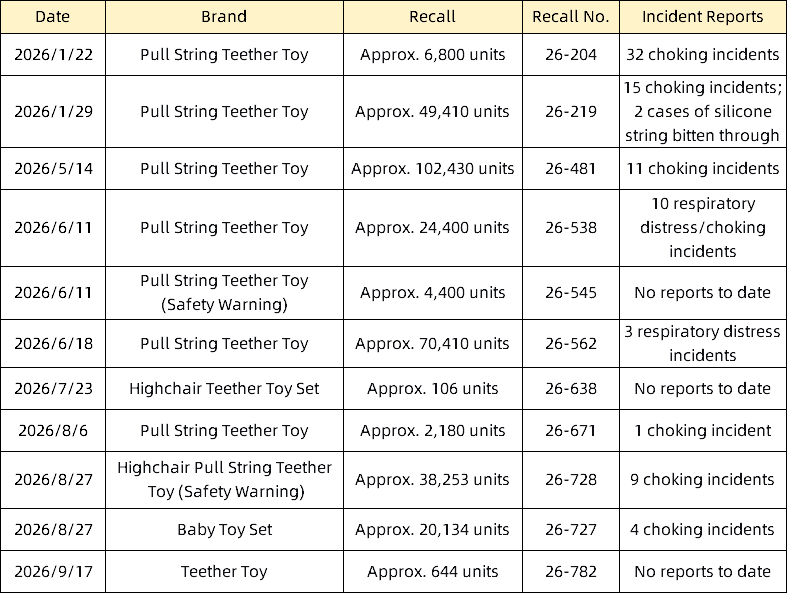
All of the recalled products were manufactured in China, and the vast majority were sold through the Amazon platform, with prices concentrated in the US$10-19 range. Of particular note, in two of these recall cases, after the CPSC issued a violation notice to the seller, the seller refused to cooperate with the recall, and the CPSC was compelled to issue a safety warning directly to consumers, urging them to immediately stop using and destroy the products. This means that refusing to cooperate with a recall not only fails to resolve the problem but also exposes the company to harsher public warnings from the CPSC and escalated enforcement.
II. Analysis of the Core Hazards Behind the Recalls: Why Are Pull String Teethers So "Dangerous"?
Pull string teether toys typically consist of a silicone disc, a central ball, and multiple silicone pull-string "tentacles" threaded through the body. They are designed to help babies develop grasping skills and sensory exploration. However, this seemingly simple structure conceals a potentially fatal risk:
(1) Teether Shape and Size Risk: The silicone strings are typically long, and their small ends can fit into a child's mouth; a child may insert them into the throat, creating a choking risk. According to the CPSC recall notices, all of the above products feature slender silicone strings that may reach into the back of a child's throat and become lodged, causing respiratory distress and choking hazards, in violation of the mandatory toy safety standard. These strings may reach into the back of a child's throat and become lodged, causing respiratory distress and a risk of fatal choking.
(2) Small Parts Choking Risk: The silicone strings of such toys can easily break under a child's biting and detach, creating small parts. In one pull string teether toy recall incident, the incident reports received by officials included two cases in which children were able to bite off fragments of the silicone string. These small broken fragments may be swallowed by children, posing an additional small-parts choking risk.
In addition, pull string teether products also face a choking risk caused by the detachment of small parts. On some products, small components such as beads and teething tips can detach easily, and a child may place them in the mouth, resulting in choking. This means that even if the string dimensions comply with the requirements, the overall structural design of the product may still contain hidden hazards.
III. Compliance Review: How Can Manufacturers Avoid Recall Risks for Such Products?
Regulatory Requirements:
1.Small Parts Requirements: 16 CFR Part 1501 and the mandatory toy safety standard ASTM F963 clearly require that toys intended for children under 3 years of age must not, before or after abuse testing, produce any small part that fits completely into the small parts cylinder;
2.Teether Shape and Size Requirements: The mandatory toy safety standard ASTM F963 contains specific requirements for teethers and teething toys: no part of a teether or teething toy may protrude beyond the base of Test Template A; a teether with ends that are approximately spherical, hemispherical, or circular and flared must be designed so that these ends do not protrude beyond the base of Test Template B during testing.
3.String Length Requirements: According to ASTM F963, a string on a toy intended for children under 18 months must not exceed 12 in. (300 mm) in length when subjected to a 2.25 kg (5 lb) pull; if the toy contains two or more strings posing an entanglement risk, the loop formed by the entangled strings must not pass through the head probe.
Recommendations for Manufacturers:
1. String Dimension Review: Accurately measure the diameter and length of all silicone strings in pull string teether products to ensure compliance with the ASTM F963 requirements for Test Templates A and B. Focus on whether the strings can penetrate the test template that simulates a child's throat—this is the most central violation identified in CPSC recalls. The free length of strings on products for children under 18 months should be kept within 300 mm, and for products with two or more entangleable strings, the loop formed must not pass through the head probe during testing.
2. String Structural Safety Verification: Check the bite-resistance of the silicone strings to ensure that they will not break and create small parts under normal use conditions.
3. Small Parts Detachment Testing: In accordance with 16 CFR Part 1501, conduct pre-use abuse testing on the product to ensure that small components such as beads and teething tips will not detach under normal use and reasonably foreseeable abuse conditions, and that any detachable component must not fit completely into the small parts cylinder.
Friendly Reminder:
CTT offers professional toy testing services to help you identify compliance risks, develop recall response plans, and avoid product delisting. Feel free to contact us—for compliant expansion into overseas markets, we stand with you every step of the way.

 Safety/EMC/Wireless
 Inspection & Audit
 Testing/Compliance/Consultation
(USA & CANADA)
Testing/Compliance/Consultation
(USA & CANADA)